.png)
Arizona Conservatorship Attorney
When an adult can no longer manage money or property effectively, an Arizona court may appoint a conservator to protect the person’s assets, pay necessary expenses, manage income, and address financial risks. Spencer Wilkinson represents family members, fiduciaries, and other interested parties in Arizona conservatorship proceedings through JacksonWhite Law.
When Might a Conservatorship be Necessary?

A conservator manages money, property, income, investments, and financial affairs. A guardian generally makes personal, medical, and residential decisions. Depending on the circumstances, a person may need a guardian, a conservator, both, or a narrower protective order.
A conservatorship may be necessary when:
-
An adult with dementia is missing payments, giving away money, or falling victim to scams.
-
A vulnerable adult is being financially exploited by a relative, caregiver, agent, or acquaintance.
-
An adult owns substantial property but can no longer manage investments, real estate, taxes, or business interests.
-
An agent under a power of attorney is refusing to provide information or is suspected of misusing assets.
-
A person has suffered a stroke, brain injury, or serious illness and cannot manage financial affairs.
-
Funds are needed for care, housing, medical treatment, or other support, but no one has authority to access them.
-
A lawsuit, inheritance, insurance payment, or settlement requires court-supervised management.
-
Assets are at immediate risk of transfer, foreclosure, waste, theft, or dissipation.
-
Family members disagree about who should control the adult’s finances.
Arizona law permits appointment when clear and convincing evidence establishes both that the person cannot effectively manage the person’s estate and affairs and that property may be wasted or dissipated, or that protection is necessary to obtain or provide funds for support, care, or welfare. The question is not merely whether someone else would manage the money better. Poor spending decisions, family disagreement, or an unconventional financial choice may not independently justify removing financial control.
Arizona Conservatorship Process
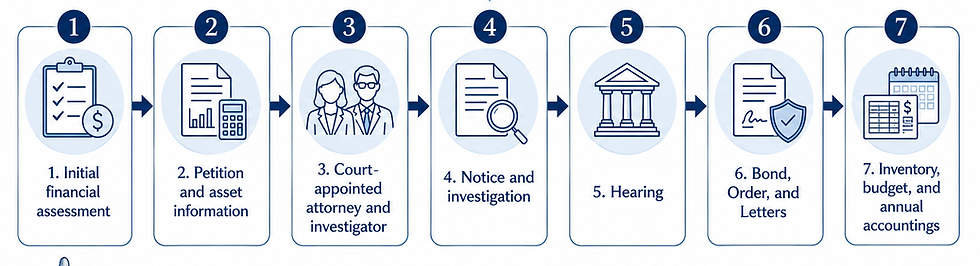
How the Arizona Conservatorship Process Works
An Arizona conservatorship proceeding involves more than obtaining authority over another person’s accounts. The court must determine whether the adult can effectively manage the adult’s estate and financial affairs, whether money or property requires protection, and whether appointing a conservator or entering a narrower protective order is appropriate.
The specific process may vary depending on the assets involved, the urgency of the financial risk, the proposed protected person’s condition, and whether anyone objects. Most adult conservatorship proceedings, however, involve the following stages.
1. Initial Financial Assessment
Before filing a petition, the petitioner and counsel should identify the financial problem that requires court intervention. This may include unpaid expenses, suspected exploitation, declining investments, threatened foreclosure, unauthorized transfers, inaccessible accounts, or an inability to arrange payment for care.
The initial assessment should identify the adult’s assets, income, debts, recurring expenses, estate-planning documents, existing agents, trustees, and potential financial risks. It should also consider whether the problem could be addressed through a durable power of attorney, trust administration, representative-payee arrangement, restricted account, single protective transaction, or another less restrictive alternative.
Arizona law permits the court to authorize particular financial transactions or protective arrangements without appointing a permanent conservator when continuing conservatorship protection is unnecessary.
2. Petition and Asset Information
The proceeding begins with a petition asking the Superior Court to appoint a conservator or enter another appropriate protective order. The petition must explain the petitioner’s interest, identify the proposed protected person and proposed conservator, describe why financial protection is necessary, and provide a general statement of the estate and its estimated value.
The petition must also disclose known durable powers of attorney, health care powers of attorney that nominate a conservator, and the adult’s vested interests in trusts. These disclosures help the court determine whether someone already has authority to act and whether conservatorship is necessary.
Additional filings commonly include the proposed conservator’s affidavit, probate information forms, consents or waivers when appropriate, proposed orders, and information concerning the proposed conservator’s qualifications and priority for appointment. Depending on the proposed conservator and the court’s requirements, fingerprinting and a criminal background investigation may also be required.
3. Court-Appointed Attorney and Investigator
Unless the proposed protected person has retained counsel of the person’s own choosing, the court appoints an attorney to represent that person. The appointed attorney advocates for the proposed protected person’s legal interests and may challenge the petition, request a narrower order, present evidence, or otherwise participate in the proceeding.
When the alleged need for protection is based on mental illness, mental deficiency, mental disorder, physical illness or disability, chronic drug use, or chronic intoxication, the court also appoints an investigator to interview the proposed protected person. The investigator submits a written report to the court before the hearing.
The court may also order an appropriate medical or psychological evaluation. Unlike an adult guardianship proceeding, a separate medical examination is not automatically required in every conservatorship case.
4. Notice and Investigation
The petitioner must provide legally sufficient notice of the hearing to the proposed protected person and other individuals entitled to participate. Those individuals may include the person’s spouse, parents, adult children, existing guardian or conservator, custodian, and anyone who has filed a demand for notice.
The proposed protected person must generally be personally served at least fourteen days before the hearing. A waiver of notice by the proposed protected person is ineffective unless that person attends the hearing. The notice must also advise the recipient of the right to request a jury trial.
During the investigation, the investigator may examine the circumstances leading to the petition, the adult’s financial decision-making abilities, the need for court protection, and the suitability of the proposed conservator. The parties may also gather bank statements, transaction histories, powers of attorney, trust documents, property records, medical information, witness testimony, and other evidence relevant to the requested appointment.
5. Hearing
At the hearing, the court considers the petition, the investigator’s report, any evaluation ordered by the court, testimony, documentary evidence, and objections raised by the proposed protected person or other interested parties.
The proposed protected person has the right to attend the hearing, be represented by counsel, present evidence, and cross-examine witnesses. Except in circumstances involving confinement, foreign detention, or disappearance, the proposed protected person generally must appear in person or virtually unless evidence establishes the person’s inability or unwillingness to attend.
For an adult conservatorship, the court must find by clear and convincing evidence that both of the following are true:
-
The adult cannot effectively manage the adult’s estate and financial affairs because of a qualifying condition or circumstance.
-
The adult has property that may be wasted or dissipated without proper management, or financial protection is needed to provide funds for the adult’s support, care, or welfare.